 Pauliina Flam
I had planned a day trip from Kraków, but not the destination in the way I usually do. I didn’t research, didn’t save places on a map, didn’t read what I was supposed to see. I searched for day trips, chose the first place on the list I hadn’t been to yet, and got on a train without knowing what awaited me. That place turned out to be Tarnów.
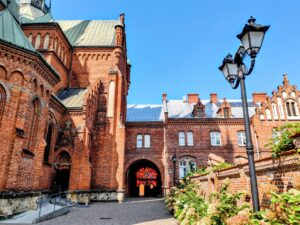
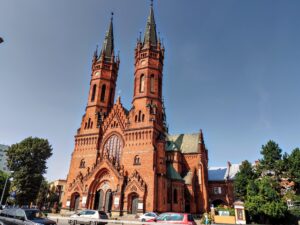
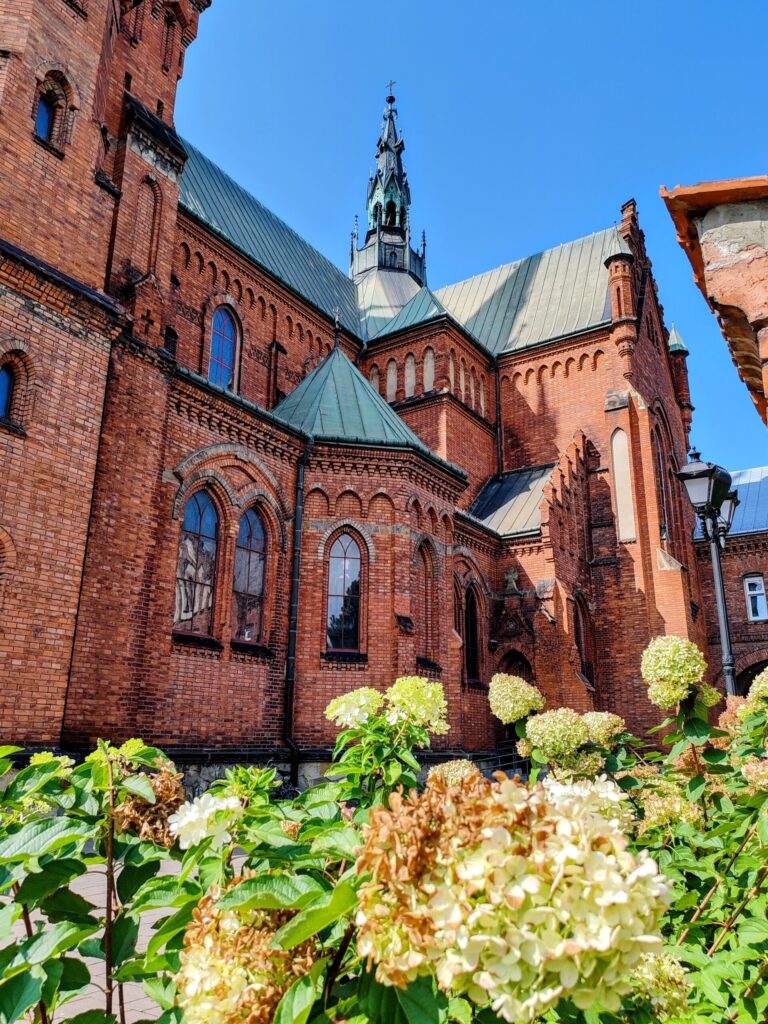
I stepped off the train and started walking toward what I assumed was the centre or the old town. And then this happened – a massive brick neo-Gothic church rose in front of me. Standing casually in the middle of running cars and busy streets with its mighty towers cutting into the sky. Around it were bushes of white flowers—large, round, almost weighty in themselves. White, but not light. There was a passage decorated with colourful stained glass, unexpectedly vivid against the scale of the structure. This is the Church of The Holy Family.

The building was grand and massive, the way Gothic architecture tends to be, and yet inside it treats visitors with yellow walls and traditional ornaments. The colors are warm pinkish and pale yellow. Subtle delicate golden details hints of magnificence. It is peculiar how here the grandeur does not cancel the lightness but the two find a way to coexist. Like the building assumes the heaviness of Gothic, and then quietly refuses its gloom.

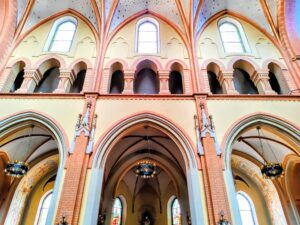

Walking the tall hall and admiring the high ornamented ceiling felt like a gateway to the past, which is ironic, because it isn’t that old. Built in the early twentieth century, it’s a relatively new church, designed to echo something older than itself. Not ancient, not inherited, but chosen.
Only later did I start looking it up, standing there with my phone in hand. I read that the church bell was the first in the country to ring for a free Poland in 1918. You see, Tarnow was the first city to become independent and the whole country followed after it. I also learned that the architect, Jan Sas-Zubrzycki, made it his duty to create a distinctly Polish kind of Gothic—separate from German or French traditions. Maybe this is exactly what it is? This very thing that feels like grandeur and lightness coexisting?
After a while, I stepped back outside and continued walking toward the centre. I looked back at the church one last time, and noticed the white flowers again. Hefty in form, but pale in colour. And it suddenly made sense—they matched the building after all, holding the same contradiction: light and heavy.
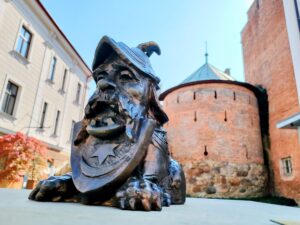
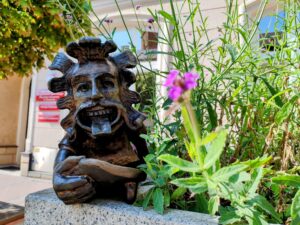
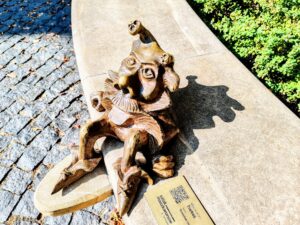
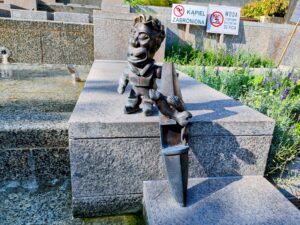
Soon I learned that Tarnów is full of interesting details and quiet surprises. The first one I encountered was a small metal book reader casually sitting by the sidewalk. Later, I found more of them — a tongue-out dude, and another one with a fancy hat. What seemed like randomly popping up metal creatures turned out to be something quite intentional: the Mascarons of Tarnów.
These small sculptures appear in places of significance, forming a trail that can guide you for about an hour through key locations connected to the city’s history. I don’t know how many of them exist at the moment, but certainly more than ten. Enough to keep you alert, walking slowly, looking twice.
Another peculiar detail I noticed was a heart-shaped tank for plastic caps, casually standing on a square behind flowers and benches. It’s a simple but beautiful local way to involve passersby in charity. Plastic caps are made of a more valuable material than bottles themselves, so they are collected, recycled, and turned into money for good causes. One ton of caps can fund a wheelchair or several weeks of rehabilitation for a child — just as an example. Subtle, but significant. Somehow, it felt very Polish.
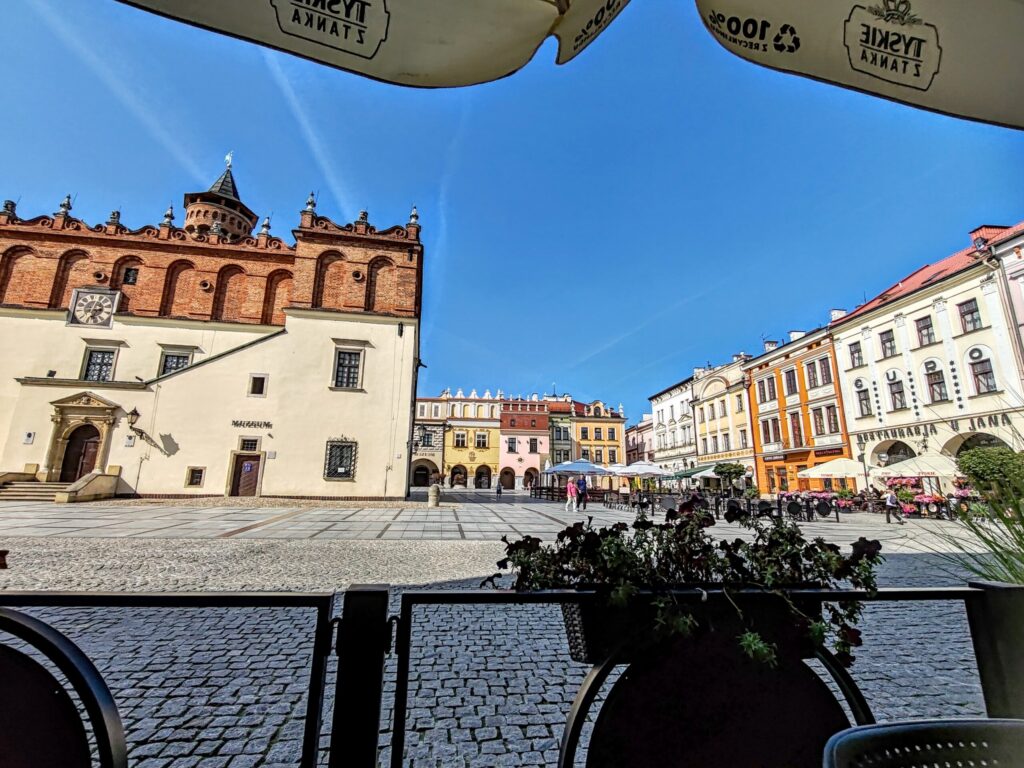
Eventually, I reached the market square and took a amoment to admire the town hall, settled right in the middle like a crown jewel. It’s a neat building with Renaissance character, crowned by a tower that draws the eye from every angle. You can admire it from under branches, through arches, from open space — it looks pretty from any direction. It also felt like a gathering place for the mascarons I had seen earlier: fourteen carved faces decorate the attic, watching over the square.


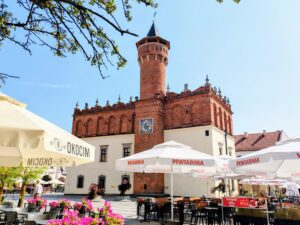
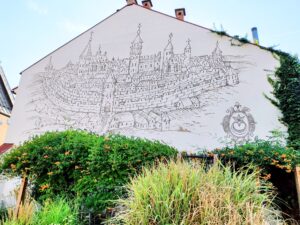
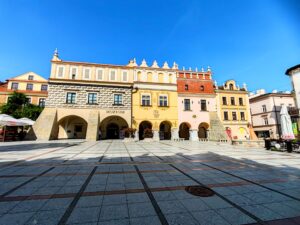
Some of the light-coloured houses around the square have arches, once used to keep merchants’ goods safe from rain. During the Renaissance and Baroque periods, Tarnów was a city of makers and an important trade hub. If you walk slowly behind the houses and look closely, you’ll find a gallery of artisans painted on one of the buildings. It celebrates craftsmen — weavers, bakers, makers of everyday things — and honestly, it kinda looks like an early version of LinkedIn.
Following the street beyond the gallery, I reached a fenced arch at the end of the road. I followed the green roof and suddenly found myself facing the remains of an old synagogue. In 1939, Tarnów’s synagogue was burned by Nazis and later demolished. What remained is the Bimah — the place from which the Torah was read during ceremonies. Today it proudly stands fenced, in the middle of a square.
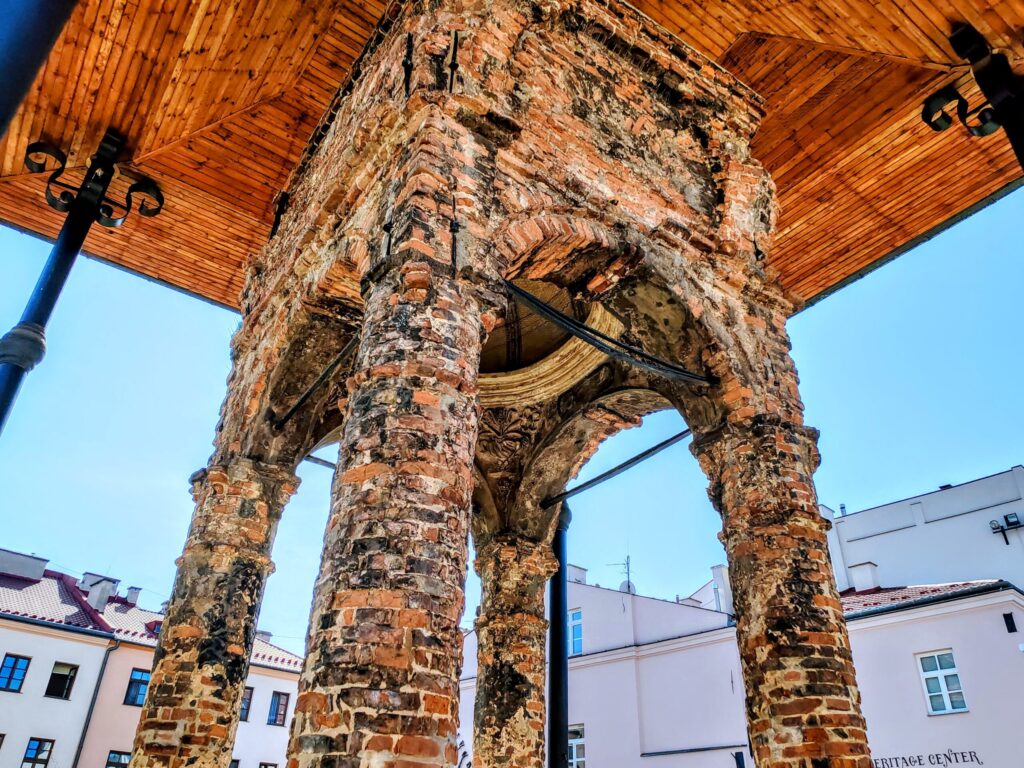
As I wandered around, a group of young people sat leaning against the old stone, drinking energy drinks and laughing. I found it comforting. Centuries of history becoming a casual hangout spot for local youth. To me, it felt like a sign that history hasn’t been frozen — that it’s local, familiar, and close enough to lean against.
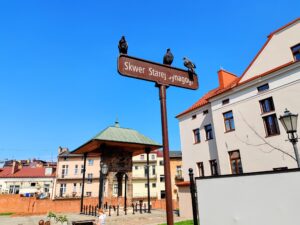
On the other side of the square, there’s a metal tree sculpture set against a light wall. Today it’s completely claimed by pigeons, which feels oddly fitting. The tree becomes more alive because of them, as if it was real. And in a way, it is. If you step close enough, you can hear a heartbeat. Small plaques with names are attached to the trunk. This is the Tree of the Righteous — a place dedicated to those who risked their lives to save Jews during the WW2.

I lingered there for a while, trying to breathe in all the history the square holds, before making my way back toward the market square in search of a drink. I noticed the word browar, which in my experience usually means it’s time for a good beer. Moments later, I was trying something special: Tyskie z Tanka — an unpasteurized lager poured directly from the tank, with a strict fourteen-day limit after opening. It’s served only in select places, and one of them happens to be here in Tarnów. Honestly, the beer itself wasn’t extraordinary — but the view absolutely was.
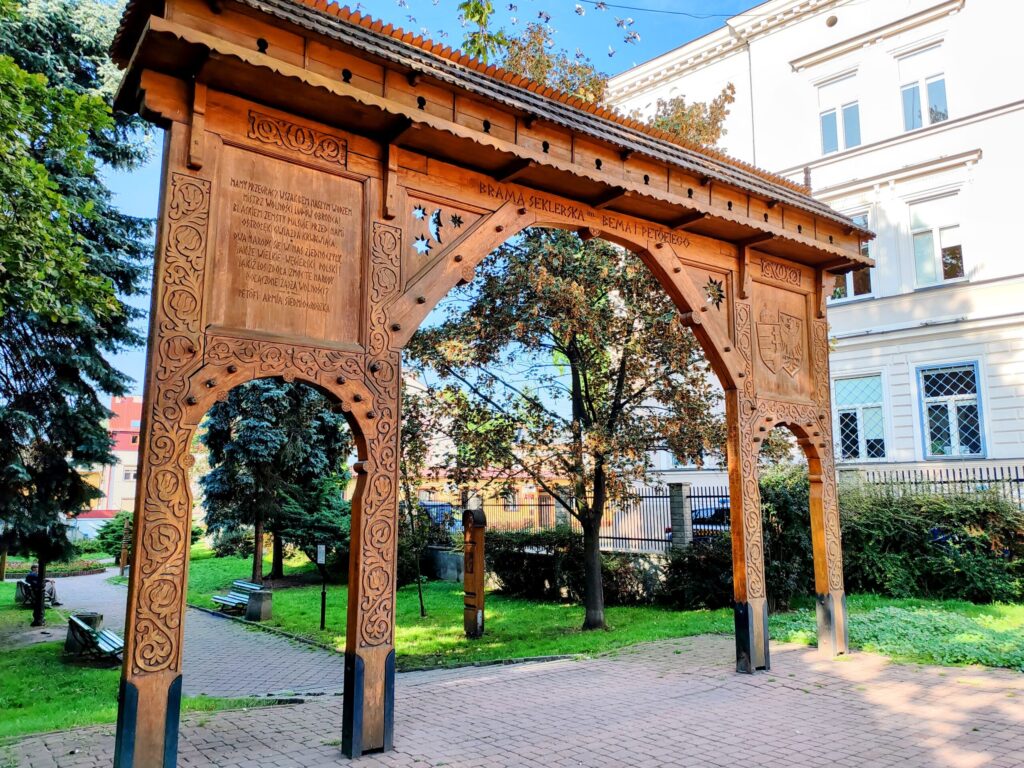
I wandered through another square with fountains and a street-art city map, found yet another small metal being along the way, and slowly headed back toward the train station. Just before leaving, I noticed one last peculiar detail: a wooden carved gate. It looked strikingly different from everything around it. It turned out to be a gift from Hungary, carved in traditional Hungarian style. There are only three gates like this in the entire country — and somehow, I stumbled upon one of them here in Tarnów. These gates celebrate shared history and friendship between Poland and Hungary.
I walked through Tarnów under golden sunlight, which brightened the building colours, flower-filled squares, and hidden corners. That isn’t accidental — Tarnów is the warmest city in Poland, known for its long summers. I even caught a piece of that warmth in mid-September.
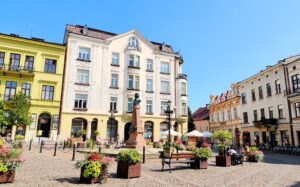
Tarnów is cute, neat, and full of quiet surprises, colour, and history. Everything that looks simple carries a heavy story or a heartfelt project behind it. And everything that looks massive and grand is eased with light colours and subtle beauty. That’s Tarnów for me — a city of contradictions.